2
Architectures Compared
0
Labelled Examples Needed
100%
Unsupervised
2M+
Records Processed
Overview
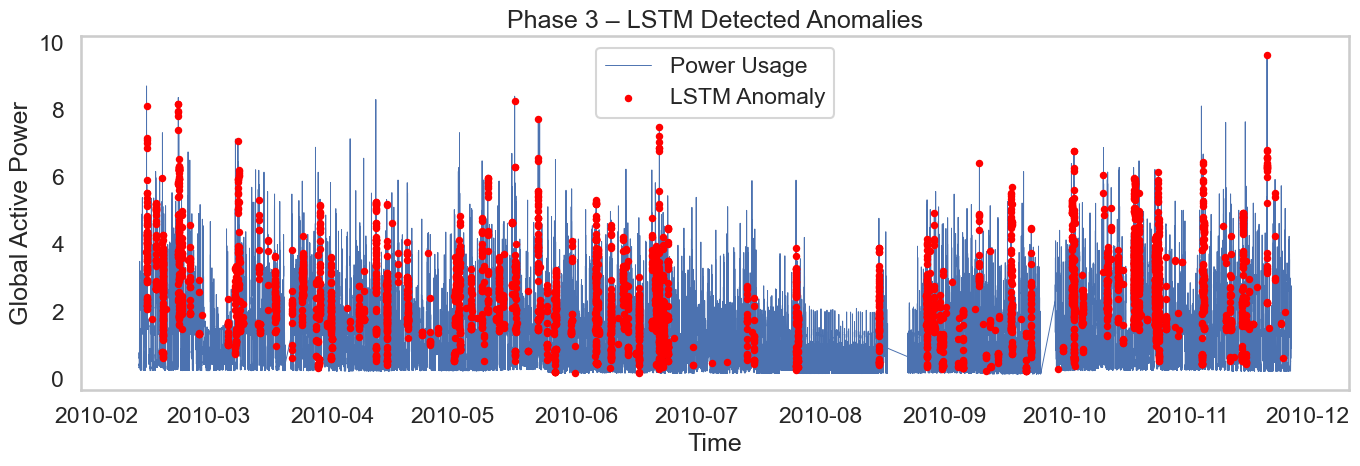
Infrastructure systems - power grids, servers, network loads — generate continuous time-series signals. Anomalies in these signals often precede failures, but labelling historical data as "normal" or "anomalous" is expensive and often impossible. Infra Anomaly AI solves this with an unsupervised approach: train the model only on normal signal behaviour, then flag anything it struggles to reconstruct.
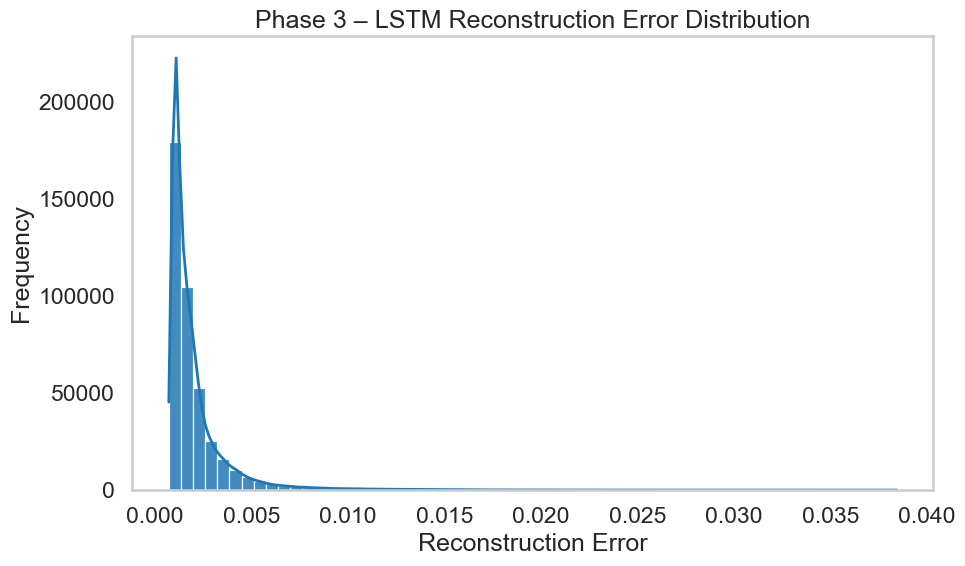
The project compares two autoencoder architectures — a Dense (fully connected) Autoencoder and an LSTM Autoencoder — evaluating reconstruction error, anomaly detection precision, and sensitivity to temporal patterns in the load signal.
Architecture Comparison
Dense Autoencoder
- Encodes each time window as a flat vector through fully connected layers
- Learns a compressed latent representation of normal signal shape
- High reconstruction error at anomalous windows triggers detection
- Fast training, good baseline - less sensitive to temporal ordering
LSTM Autoencoder
- Encoder LSTM compresses sequential patterns into a context vector
- Decoder LSTM reconstructs the sequence from compressed state
- Explicitly models temporal dependencies - better for periodic signals
- Higher capacity for detecting subtle drift and pattern shifts over time
Tech Stack
TensorFlowKerasLSTM Autoencoder
Dense AutoencoderTime SeriesUnsupervised Learning
PandasNumPyMatplotlibSeaborn